


There are many differences between LED and OLED screens, and their respective advantages
Nov 12, 2024
Leave a message
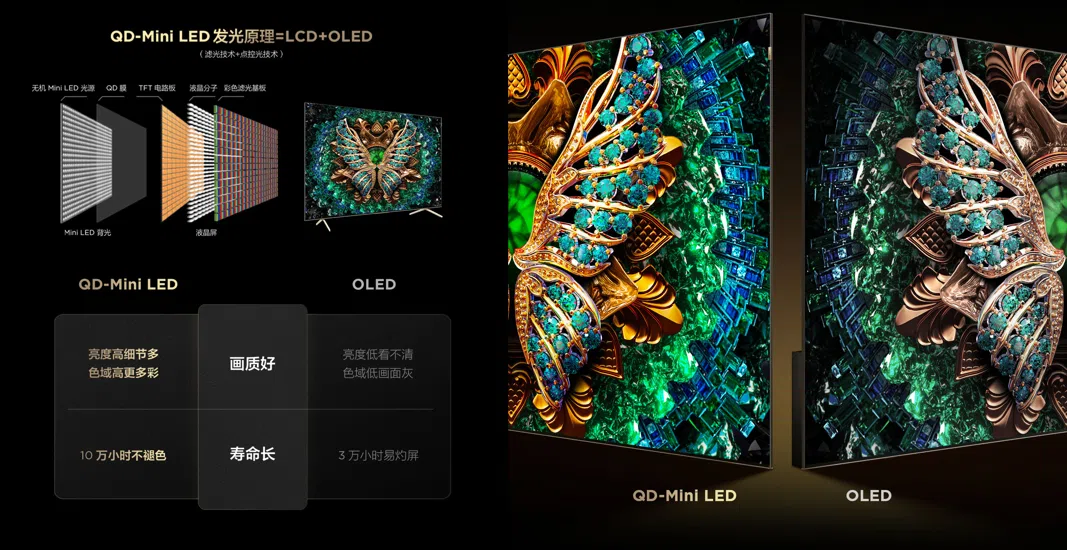
Luminous Principle:
LED: It is a light-emitting diode made of inorganic semiconductor materials. Its screen uses a backlight source (usually LED lamp beads or fluorescent tubes) to illuminate the screen. The liquid crystal layer is used to regulate the passage and blocking of light, and the liquid crystal screen or other types of panels are illuminated by the backlight to display content.
OLED: Made of organic light-emitting materials, each pixel is a small organic light-emitting diode that can directly generate light and emits light spontaneously when current passes through it, without the need for a backlight source.
Pixel Independence:
LED: The distributed backlight source is composed of multiple pixels. The backlight source is controlled as a whole, and the independence of pixels is relatively weak, unable to precisely control the lighting of each individual pixel.
OLED: Each pixel can be independently turned on or off, enabling pixel-level precise control.
Display Effects:
Contrast Ratio: OLED screens can achieve true pure black, with a higher contrast ratio, and can present more vivid and vivid pictures. Due to the existence of the backlight source, LED screens cannot completely turn off the light when displaying black, resulting in a certain amount of light leakage, making the black display less pure and the contrast ratio relatively lower.
Color: The colors of OLED are more vivid and saturated, with a wider color gamut, able to present more abundant color gradations. The color performance of LED screens is relatively ordinary, generally capable of achieving a 72% NTSC color gamut, while OLED can reach 100% NTSC (meeting the requirements of higher color gamuts such as BT2020).
Screen Thickness and Curvature:
Thickness: OLED screens do not require a backlight structure and are generally thinner, usually about one-third or even thinner than LED screens.
Curvature: OLED screens are flexible and easier to bend, and can be used to manufacture special-shaped screens such as curved screens. LED screens are relatively thicker and stiffer and not easy to bend.
Response Time:
OLED: The response time is very fast, usually within the millisecond range, and no obvious smearing phenomenon will occur when displaying dynamic pictures, making the pictures clearer and smoother.
LED: The response time is relatively slow, usually within the microsecond range.
Power Consumption:
OLED: Each pixel works independently. When displaying dark or black pictures, the pixels can be directly turned off without emitting light, so the power consumption is lower. In scenarios with lower display brightness, the energy efficiency is also relatively high.
LED: The backlight source needs to be continuously lit regardless of the displayed content, so the power consumption is relatively high, especially when displaying white or bright content, which consumes a large amount of electricity. However, with the maturity of current technology, it is also relatively energy-efficient.
Lifespan:
OLED: The organic materials in the screen may be damaged after long-term use, resulting in problems such as image retention (burn-in), and the lifespan is usually between 50,000 and 100,000 hours.
LED: Generally, it has a relatively long lifespan, usually between 100,000 and 200,000 hours, and there is no burn-in problem.
Send Inquiry