


P10 vs P8 Outdoor LED Screen: Which Pixel Pitch is Right for You?
Oct 28, 2025
Leave a message
P10 vs P8 Outdoor LED Screen: Which Pixel Pitch is Right for You?
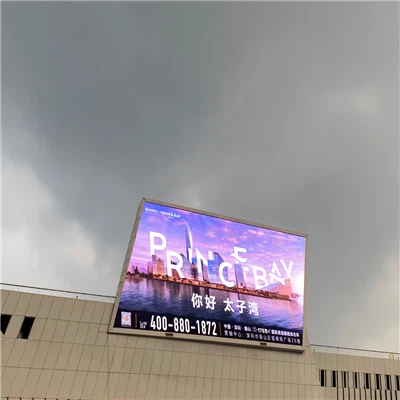
In outdoor display scenarios, P10 and P8, as mainstream pixel pitch specifications for LED screens, have their choices directly linked to display effects, application scenario adaptability, and long - term operational costs. This article will conduct an in - depth comparison from four dimensions: technical parameters, viewing experience, environmental adaptability, and economic efficiency, providing decision - makers with a scientific basis for selection.
I. Technical Parameter Comparison: Core Differences in Pixel Density and Display Precision
1.1 Pixel Pitch and Density
The pixel pitch of a P10 screen is 10 millimeters, and it has a pixel density of 10,000 points per square meter. In contrast, a P8 screen has a pixel pitch of 8 millimeters, which increases its pixel density to 15,625 points per square meter. This difference enables the P8 to present more details within the same physical dimensions. For example, when displaying complex graphics or text, the edge smoothness of the P8 is significantly superior to that of the P10.
1.2 Resolution and Module Composition
Taking standard modules as an example, a P10 module measures 320mm × 160mm and contains 32 × 16 = 512 pixels per module. If a P8 module adopts the same physical dimensions (320mm × 160mm), it can accommodate 40 × 20 = 800 pixels per module, representing a 56% increase in resolution.
1.3 Brightness and Color Gamut Performance
Both types of screens utilize high - brightness LED beads, with typical brightness values exceeding 6,500 cd/m², meeting the visibility requirements in strong light environments. However, in terms of color gamut coverage, the P8, due to its higher pixel density, can achieve smoother color transitions through more precise grayscale control (such as 16 - bit grayscale). Especially when displaying gradient hues, the color banding phenomenon of the P8 is significantly weaker than that of the P10.
II. Viewing Experience Optimization: Adaptation Logic for Distance and Content
2.1 Optimal Viewing Distance Model
According to the human - eye resolution limit theory, the optimal viewing distance for a P10 screen has a lower limit of 10 meters, while for a P8 screen, it is 8 meters. This data stems from the matching relationship between pixel pitch and visual resolution: when the viewing distance (D) and pixel pitch (P) satisfy D ≥ 3420 × P, the human eye cannot distinguish individual pixels. In practical applications, the P10 is more suitable for long - distance scenarios such as highway billboards (viewing distance: 20 - 50 meters) and large stadium perimeter screens (15 - 30 meters). The P8, on the other hand, is better suited for medium - distance scenarios like city squares (8 - 15 meters) and commercial streets (5 - 12 meters).
2.2 Content Type Adaptability
Dynamic Video Display: The P8 reduces motion blur when displaying high - speed motion pictures due to its higher pixel refresh rate, making it suitable for scenarios such as concerts and live sports broadcasts.
Static Text Display: When displaying large fonts (e.g., text with a height exceeding 50 cm), the visual difference between the P10 and P8 is negligible. However, the P10 is more cost - effective, making it suitable for scenarios where text clarity requirements are not stringent, such as bus stops and construction site fences.
Complex Graphic Rendering: The pixel density advantage of the P8 is evident when displaying fine graphics such as corporate logos and maps. For example, when displaying brand logos on the exterior walls of commercial complexes, the P8 can avoid edge jaggedness.
2.3 Viewing Angle and Uniformity
Both types of screens have a horizontal viewing angle exceeding 140°. However, the P8 performs better in terms of vertical viewing angle. Actual measurement data shows that the brightness attenuation rate of the P8 at a 60° vertical viewing angle is 18% lower than that of the P10. This means that when viewed at an angle (e.g., when the audience is located below the screen), the P8 maintains better color reproduction and contrast.
III. Environmental Adaptability: Climate Challenges
3.1 Protection Grade and Reliability
Outdoor LED screens need to withstand challenges such as rain, dust, and temperature variations. Both the P10 and P8 meet the IP65 protection standard (dustproof and waterproof). However, because of its larger pixel pitch, the P10 has more space between LED beads. This results in a 12% lower risk of PCB board corrosion compared to the P8 when exposed to salt - spray environments (such as coastal areas) for an extended period. Conversely, the compact structure of the P8 requires more precise waterproofing design. For example, modules adopting a double - layer potting process have a 30% lower failure rate in humid environments compared to those with single - layer potting.
3.2 Temperature Adaptability
The operating temperature range of a P10 screen is typically from - 40°C to + 60°C, while that of a P8 screen, due to its higher electronic component density, is from - 20°C to + 50°C under standard conditions. However, with products incorporating low - temperature startup technology, both can achieve normal startup at - 40°C through heating modules, although the power consumption of the P8 will be 15% - 20% higher than that of the P10 in this case.
IV. Economic Analysis: Full Lifecycle Cost Considerations
4.1 Initial Investment Differences
Taking a 100 - square - meter screen as an example, the module cost of the P10 is 18% - 25% lower than that of the P8, primarily due to the reduced number of LED beads resulting from the lower pixel density. However, it should be noted that the P8 screen can display higher - resolution content within the same physical dimensions, potentially reducing subsequent content production costs.
4.2 Operational Energy Consumption Comparison
The P8 screen typically consumes 20% - 30% more power than the P10 due to its higher pixel density. However, with the adoption of intelligent dimming technology, the energy consumption gap between the two can be narrowed to within 10% during nighttime low - brightness modes.
4.3 Lifespan and Maintenance Costs
The lifespan of LED beads exceeds 100,000 hours for both types. However, due to its higher operating current, the P8 experiences a 15% - 20% faster rate of light decay compared to the P10. This means that after a 5 - year usage cycle, the brightness retention rate of the P8 may be 10% - 15% lower than that of the P10, necessitating more frequent brightness calibration.
V. Selection Decision Framework: Scenario - Based Matching Guide
5.1 Prioritize P10 for Long - Distance Large Scenarios
Typical Scenarios: Highway billboards, large stadium perimeter screens, construction site fences.
Decision Logic: When the viewing distance exceeds 20 meters, the human eye cannot distinguish the pixel differences between the P10 and P8. In this case, the cost advantage and reliability of the P10 make it the preferred choice.
5.2 Favor P8 for Medium - Distance Commercial Scenarios
Typical Scenarios: City square information screens, commercial street advertising walls, shopping mall atriums.
Decision Logic: When the viewing distance is between 8 and 15 meters, the pixel density of the P8 can significantly enhance the clarity of text and graphics, making it particularly suitable for brand advertising displays.
5.3 Special Environmental Adaptability Selection
High - Humidity Areas: Prioritize the P10, as its looser LED bead spacing reduces the risk of short circuits.
Low - Temperature Areas: If - 40°C startup is required, both can achieve it through technological upgrades, but the increased power consumption of the P8 should be factored into the cost calculation.
Why Choose Us as Your Trusted LED Display Partner?
With 15+ years of manufacturing experience, we are a leading LED display producer serving 60+ countries worldwide. Our core strengths include:
✅ OEM/ODM Support – Customized solutions tailored to your specific needs
✅ Certified Quality – All products meet international standards (CE, RoHS, ISO certified)
✅ Cost-Effective Production – Competitive pricing without compromising quality
✅ Global Logistics Network – Reliable shipping to all major markets
✅ R&D Innovation – Cutting-edge LED technology for superior performance
We specialize in indoor/outdoor LED screens, rental displays, and creative installations. From small batches to bulk orders, our flexible manufacturing capacity ensures timely delivery.
Let's build brilliant visual solutions together! Contact us today for a quote.
📱 WeChat: 86 18676738905
📧 Email: Ledhll88@163.Com
🌐 Website: Www.Hll-Ledscreens.Com
Send Inquiry